
Catheters & urology
Foley Catheter
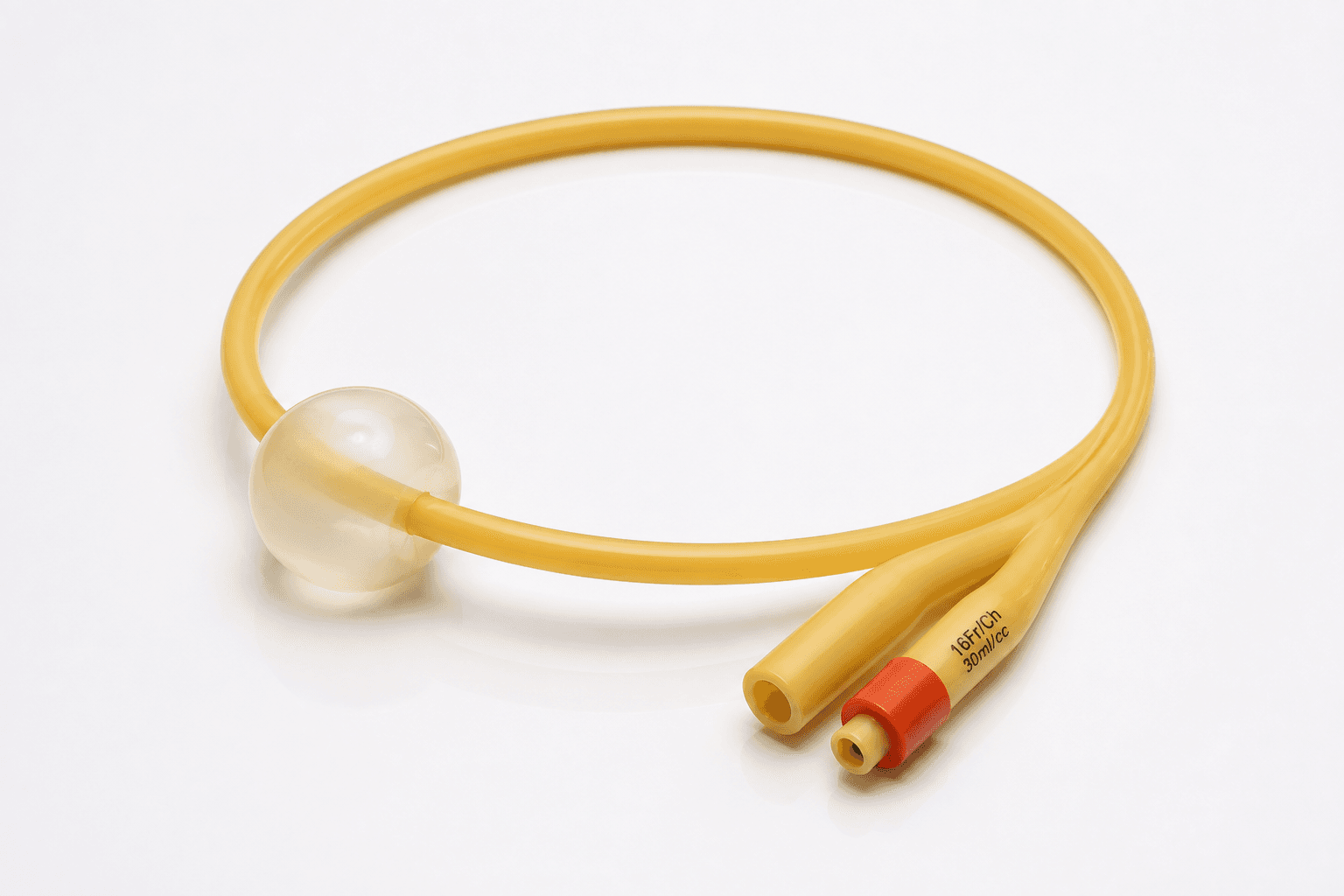
Sterile indwelling urinary catheter with a retention balloon, in silicone and latex, sizes 6 Fr to 24 Fr — placed by a trained nurse, never by an untrained carer.
Also searched as: urine ki nali · peshab ki pipe · urinary catheter · bladder tube
This is a clinical item. Read the safety information below before use. If nobody in the household has been trained, tell us when you order and we will arrange a nurse rather than leave you to it.
Get the best quote
Consumables are quoted by size and quantity, and it is usually cheaper per unit to set up a standing reorder than to buy pack by pack. Tell us the situation and we will work the sizes out with you.
Quotes state GST separately at the applicable rate.
What it is for
A Foley catheter drains the bladder continuously through a soft tube held in place by a small balloon inflated inside the bladder. It is used for patients who cannot pass urine, who cannot get to a toilet at all, or whose urine output has to be measured accurately. It is also the single most common source of infection in home care, which is why the useful advice is not about the catheter but about how long it stays in: every extra day raises the risk, so it comes out as soon as it is no longer needed rather than being left because it is convenient.
Sizes & variants
- Sizes
- 6, 8, 10, 12, 14, 16, 18, 20, 22, 24 FrFr is circumference in millimetres. Larger is not better — it causes more urethral trauma.
- Material
- All-silicone or latex with silicone coatingAll-silicone for latex allergy, and for anyone catheterised long-term.
- Ways
- 2-way (drainage) and 3-way (with irrigation channel)
- Balloon
- 5–10 ml or 30 ml
- Supplied
- Sterile, individually wrapped, single-use
How to use it properly
- Placed by a trained nurse under aseptic technique — Encone Care can send one.
- Never inflate the balloon until urine is actually flowing.
- The drainage bag stays below bladder level at all times, including during transfers.
- Meatal hygiene daily with soap and water. No antiseptics unless a clinician says so.
- Write down the insertion date; changes follow the clinician's schedule, not appearance.
Also know about
- Leakage usually means spasm, not a small catheter
- Urine bypassing the catheter is most often bladder spasm or a blockage. Replacing it with a larger size typically makes the spasm worse rather than better — ask the clinician before sizing up.
- Infection risk is about duration
- Catheter-associated urinary tract infection risk accumulates daily. The most effective thing anyone can do is ask, at every review, whether it can come out yet.
- Secure the tubing
- A catheter tugged by an unsecured tube causes urethral trauma over time. Use a leg strap or fixation device.
- Cloudy or foul urine needs a call, not a flush
- Home flushing of a blocked or infected catheter without instruction pushes organisms upward. Call the treating clinician.
Safety & clinical information
Device information, not medical advice. Suitability for a particular patient is a decision for the treating clinician.
How it is installed and used
Inserted by a trained nurse under aseptic technique: hands washed and gloved, the meatus cleaned, sterile lubricant instilled, the catheter advanced until urine flows, then the balloon inflated with the stated volume of sterile water and the drainage bag hung below bladder level. Never inflate the balloon before urine is seen.
Before delivery
The size and type are a clinical decision — a larger catheter is not a better one and causes more urethral trauma. Confirm latex allergy status before choosing a latex-based catheter.
Ongoing care and servicing
The bag stays below bladder level at all times, including during transfers, or urine flows back into the bladder. Meatal hygiene daily with soap and water. Catheters are changed on the clinician's schedule, not when they look dirty, and the date of insertion should be written down.
When not to use it
- Suspected urethral injury
- Blood at the meatus or a pelvic fracture may indicate urethral disruption. Passing a catheter can complete a partial tear — this needs urological assessment first.
- Insertion by an untrained carer
- Urethral catheterisation is a sterile clinical procedure. Performed without training it causes trauma, false passages and infection.
- Latex catheters in latex allergy
- Latex catheters can cause a severe allergic reaction in a sensitised patient. Use an all-silicone catheter instead.
Possible side effects
- Catheter-associated urinary tract infection
- Risk rises with every day the catheter stays in. This is the main reason catheters are removed as soon as they are no longer needed rather than left as a convenience.
- Urethral trauma and bleeding
- From an oversized catheter, inadequate lubrication, or traction on the tube when the patient moves. Secure the tubing so it cannot pull.
- Bladder spasm and bypassing
- Leakage around the catheter is usually spasm or blockage, not a catheter that is too small. Replacing it with a larger one typically makes it worse.
Serious risks
Life-threatening, permanently damaging, or requiring hospitalisation.
- Urosepsis
- A catheter-associated infection can progress to bloodstream infection, which is life-threatening particularly in elderly and immobile patients.
Regulatory status
Urinary catheters are notified medical devices under India's Medical Devices Rules, 2017, and are supplied sterile and single-use. Encone Care supplies them and makes no claim of CDSCO approval.
Relevant specialties
- Urologic
- Nursing
- Geriatric medicine
About foley catheter
How often should a Foley catheter be changed?
Can a family member insert a Foley catheter?
What size Foley catheter is needed?
Used with
Updated 6 August 2026. Product information, not medical advice — sizes and technique are decisions for the treating clinician.