Oxygen Concentrator
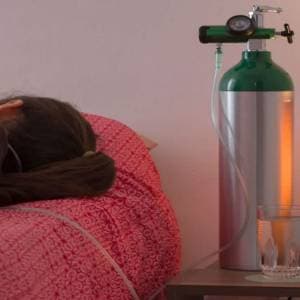
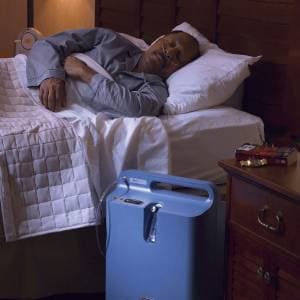
5 LPM and 10 LPM continuous-flow oxygen concentrators with humidifier, low-purity alarm and power-failure alarm — supplied only against a prescribed flow rate.
Available on rent or to buy
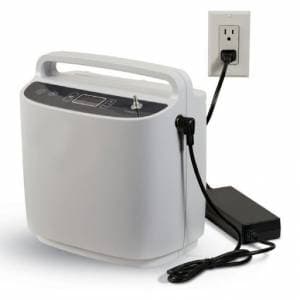
Battery-powered pulse-dose oxygen concentrator, cabin-approved and light enough to carry — for patients who need oxygen but not confinement.
Not on the rental fleet
This item is supplied for purchase. If you need something similar on rent, call us — we will tell you what the rental fleet can do instead.
Available
Outright purchase including delivery, installation and a one-year warranty on manufacturing defects.
Get the best quote for this equipment
We price against what you actually need — how long, which configuration, whether nursing goes with it — rather than publishing a number that fits nobody. Ask and we will give you a straight one, GST stated separately.
Quotes state GST separately at the applicable rate. Rental and purchase are taxed differently.
A portable concentrator runs on a battery and delivers oxygen in pulses timed to the patient's breath, rather than as a continuous flow. That pulse-dose design is what makes it small enough to carry, and it is also its main limitation — most portables cannot deliver a continuous flow, so they do not suit patients who need oxygen while asleep or who breathe too shallowly to trigger reliably. For a patient who is stable on modest daytime oxygen, it is the difference between being housebound and going to the clinic, a wedding, or their daughter's house.
Which brand you receive depends on current stock. Tell us if you need a specific one and we will confirm before dispatch.
| Delivery | Pulse dose, settings 1–5Pulse settings are not equivalent to litres per minute — confirm the setting with the treating clinician. |
|---|---|
| Continuous flow | Not available on most portable models |
| Battery life | Approximately 3–5 hours single battery, 6–10 hours double |
| Charging | Mains and 12 V car adaptor |
| Oxygen purity | 90% ±3 |
| Noise | Approximately 40 dB(A) |
| Air travel | Most models FAA-approved; confirm with the airline in advance |
| Length | 80 mm |
|---|---|
| Width | 180 mm |
| Height | 215 mm |
| Weight | 2.2–2.8 kg with battery |
The things that are easy to find out too late.
Sale only
The rental fleet carries static concentrators and cylinders. Portables are supplied for purchase.
Pulse settings are not LPM
A 'setting 3' on a portable is not three litres per minute. Delivered dose depends on breathing rate, so the setting must be confirmed against the patient's saturation by the treating clinician.
Usually not for sleep
Pulse dose relies on detecting each breath. Shallow sleeping breaths may not trigger it reliably, so most patients need a static concentrator overnight.
Tell the airline in advance
Most models are FAA-approved, but airlines require notice and usually proof of enough battery for the flight plus a margin. Do not assume it can be arranged at the gate.
Device information, not medical advice. Suitability for a particular patient is a decision for the treating clinician.
The technician fits the cannula, sets the pulse setting to the treating clinician's specification, confirms the patient triggers the device reliably at rest and while walking, checks saturation on that setting, and demonstrates battery changes and charging from both mains and a car adaptor.
A prescribed flow rate from the treating clinician is required before delivery — oxygen is not supplied on a guessed setting. Confirm a stable power supply, and for oxygen-dependent patients arrange a backup cylinder or an inverter rated for the unit's continuous load.
The gross particle filter is washed weekly and the outlet filter replaced per the manufacturer's schedule. Oxygen saturation should be monitored as directed by the treating clinician, and any change in flow rate must come from them, not from the family.
Life-threatening, permanently damaging, or requiring hospitalisation.
Classified Class B (low–moderate risk) under India's Medical Devices Rules, 2017. CDSCO does not license rental or resale providers and Encone Care claims no CDSCO approval.
We deliver across Delhi NCR only. Check your pincode, or call us and we will tell you honestly whether we can reach you.
Items usually needed alongside this one — chosen because they solve an adjacent problem, not because they cost more.
5 LPM and 10 LPM continuous-flow oxygen concentrators with humidifier, low-purity alarm and power-failure alarm — supplied only against a prescribed flow rate.
Available on rent or to buy
Portable and large medical oxygen cylinders supplied with regulator, flow meter, humidifier and trolley — for backup, transport and short-term therapy.
Available on rent or to buy
Continuous positive airway pressure machine with heated humidifier for obstructive sleep apnoea — supplied with an in-person mask fitting.
Available on rent or to buy