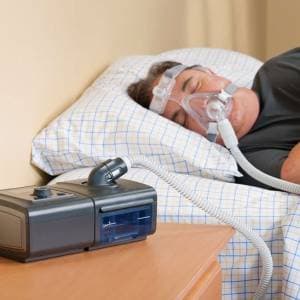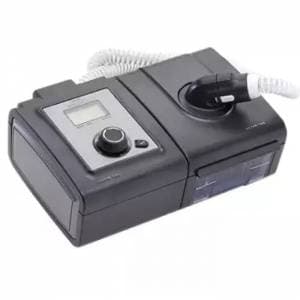
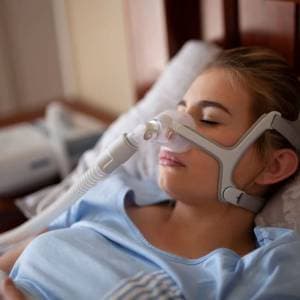
CPAP Machine
Continuous positive airway pressure machine with heated humidifier for obstructive sleep apnoea — supplied with an in-person mask fitting.
Available on rent or to buy
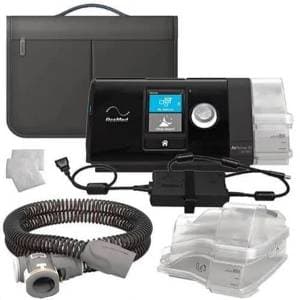
Auto-titrating CPAP that adjusts pressure breath by breath within a prescribed range — for patients whose pressure requirement varies through the night.
Not on the rental fleet
This item is supplied for purchase. If you need something similar on rent, call us — we will tell you what the rental fleet can do instead.
Available
Outright purchase including delivery, installation and a one-year warranty on manufacturing defects.
Get the best quote for this equipment
We price against what you actually need — how long, which configuration, whether nursing goes with it — rather than publishing a number that fits nobody. Ask and we will give you a straight one, GST stated separately.
Quotes state GST separately at the applicable rate. Rental and purchase are taxed differently.
A fixed CPAP holds one pressure all night, which has to be high enough for the worst moment — usually REM sleep on your back. An auto-titrating machine instead works within a prescribed range, sensing flow limitation and raising pressure only when the airway starts to narrow. Most of the night it runs lower, which is more comfortable and, for a lot of patients, the difference between using the machine and abandoning it. It also handles the case where the requirement genuinely shifts — with weight change, alcohol, position or nasal congestion.
Which brand you receive depends on current stock. Tell us if you need a specific one and we will confirm before dispatch.
| Pressure range | 4–20 cm H₂O, auto-adjusting within prescribed limits |
|---|---|
| Modes | Auto-CPAP and fixed CPAP |
| Algorithm | Responds to flow limitation, snore and apnoea |
| Humidifier | Heated, integrated; distilled water only |
| Expiratory relief | Pressure drop on exhalation |
| Data | On-board compliance, AHI and pressure-percentile logging |
| Length | 150 mm |
|---|---|
| Width | 260 mm |
| Height | 85 mm |
| Weight | Approximately 1.3 kg with humidifier |
The things that are easy to find out too late.
Sale only
The rental fleet carries fixed CPAP and BiPAP. If you want to trial auto-titration before buying, ask — we will work something out.
The range is still a prescription
Auto does not mean unsupervised. The minimum and maximum pressures come from the treating clinician; the machine chooses within them, not outside them.
Not a substitute for BiPAP
Auto-CPAP still delivers a single pressure at any moment. Patients who need help breathing out — COPD, obesity hypoventilation, neuromuscular weakness — need BiPAP.
Same mask rules apply
Fit is still the deciding factor. A leaking mask also confuses the auto algorithm, which reads leak as flow and can drive pressure up.
Device information, not medical advice. Suitability for a particular patient is a decision for the treating clinician.
The mask is fitted to the patient's face in person — nasal, nasal-pillow and full-face styles are tried rather than a medium being assumed, because mask leak is the single most common reason home therapy is abandoned. Pressures, mode and ramp are set to the clinician's prescription, the humidifier is filled with distilled water, and the settings are confirmed before the technician leaves.
A sleep study or blood gas assessment and clinician-set pressures are required before delivery. Machines are not supplied on guessed settings. Confirm mains supply and, for dependent patients, that an inverter can carry the unit overnight.
Mask cushions are replaced roughly every three months and filters monthly. Compliance data is available on the device for the treating clinician. We re-fit the mask free within the first two weeks, which is when most fit problems surface.
Life-threatening, permanently damaging, or requiring hospitalisation.
Classified Class C (moderate–high risk) under India's Medical Devices Rules, 2017. CDSCO does not license rental or resale providers and Encone Care claims no CDSCO approval.
We deliver across Delhi NCR only. Check your pincode, or call us and we will tell you honestly whether we can reach you.
Items usually needed alongside this one — chosen because they solve an adjacent problem, not because they cost more.
Continuous positive airway pressure machine with heated humidifier for obstructive sleep apnoea — supplied with an in-person mask fitting.
Available on rent or to buy
Bi-level positive airway pressure machine with heated humidifier, supplied with an in-person mask fitting and clinician-set pressures.
Available on rent or to buy
Advanced bi-level system with timed backup rate and volume-assured pressure support, for chronic respiratory failure and neuromuscular weakness.
Available to buy